Bedding · Materials & Making
What Makes Naturepedic Sheets Feel Different? Fiber, Weave, and Weight
A sheet’s character is not a single sensation but a negotiation among fiber, yarn, weave, weight, and finish. Naturepedic’s organic flax sheets offer one way to understand how those details become the texture we notice at bedtime—and how a fabric may change after a hundred nights and washes.
Published November 18, 2026
There is a small moment, just after the bed has been made, when a sheet is mostly an idea. It lies smooth and cool, or perhaps faintly rumpled; it catches the light with a quiet sheen or absorbs it into a matte surface. Later, under a sleeping body, those impressions become more specific. The cloth moves, warms, gathers, releases. A person who has never studied textiles may still know, quite precisely, what feels right.
That judgment is often filed under “softness,” a useful word that can also conceal a lot. Surface softness is only one part of a sheet’s feel. Fiber determines the raw material’s character; yarn and weave shape how the fibers meet; fabric weight influences drape and substance; and finishing can make a new textile feel crisp, smooth, or already lived in. Washing then begins its own slow work.
Naturepedic’s organic linen sheets provide a particularly clear case for looking beneath the surface. Their published specifications identify organic flax linen, a fabric weight of 185 grams per square metre, stone washing, and a looser weave. These details do not promise that every sleeper will like the same thing. They do offer a vocabulary for understanding what a sheet is likely to feel like—and for comparing it with other bedding materials.
Start with the fiber, not the adjective
Linen is made from flax. In everyday conversation, “flax” and “linen” are often treated as interchangeable, but they refer to different stages of the material’s life: flax is the plant and its fiber; linen is the textile made from that fiber. A sheet described as flax linen, then, is not made from a different substance than one described simply as linen. The wording emphasizes the botanical source.
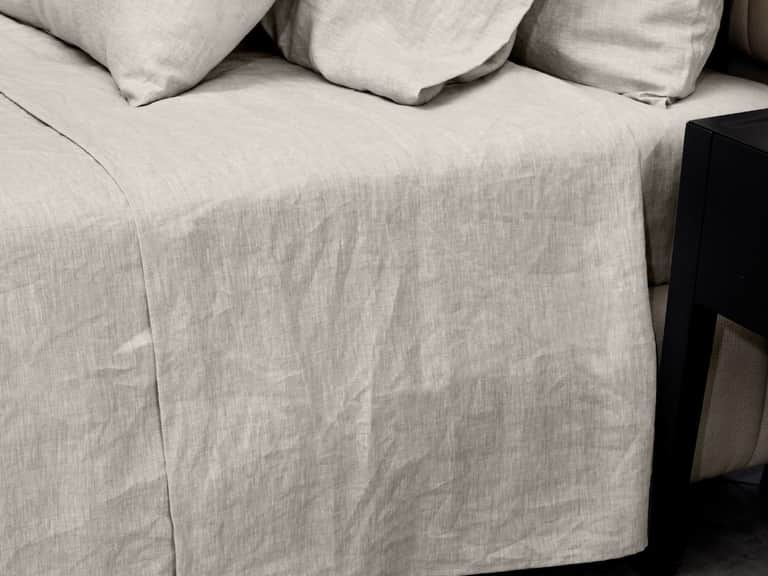
Flax fibers have a natural stiffness and a surface that can feel more textured than many finely finished cotton fabrics. That quality is not a defect waiting to be corrected. It is part of linen’s identity: a slightly irregular hand, a relaxed drape, and creases that tend to look like evidence of use rather than a household emergency. With repeated laundering, linen often becomes more supple, though the precise change depends on the yarn, the weave, the finishing, and the care routine.
The Naturepedic sheet description identifies premium certified organic flax grown in France and a GOTS-certified organic fabric. Its listed specifications also state that the sheets are made in India in a GOTS-certified organic facility. Those are useful provenance details, but they describe separate parts of a supply chain: where the flax is grown and where the finished bedding is made. A careful reader should not collapse them into a single claim about origin.
Organic certification can help clarify how a product was assessed against a particular standard, but it is not a universal shortcut for judging every aspect of a textile. It does not, by itself, tell you whether a sheet will feel soft, whether its weave suits a warm room, or how long it will last in your laundry routine. For those questions, the material composition and construction still matter.
What the weave contributes
Fibers do not lie in a sheet as a loose crowd. They are spun into yarns and interlaced in a weave. The weave determines how those yarns cross, how closely they sit, and how much space remains between them. It can influence a fabric’s surface, flexibility, airflow, and resilience. Even when two sheets share the same fiber, their behavior can differ because their construction differs.
Naturepedic describes its linen sheets as having a looser weave. That phrase points toward a more open structure than a tightly packed cloth, although the description alone does not give a complete technical account of the weave. An open construction may allow air to circulate readily and can contribute to a less compact, more relaxed hand. It may also make the fabric feel less smooth and uniform than a densely woven sheet. For some people, that tactile grain is the pleasure; for others, it takes time to appreciate.
“Breathable” is often used as though it were a single measurable sensation. In practice, comfort at night involves several things at once: air movement through the cloth, how the textile handles moisture, how much warmth it retains, and the conditions of the room and sleeper. Linen is commonly valued for air circulation and moisture management. Those properties can make it appealing to people who tend to sleep warm, but they cannot guarantee that any particular sheet will feel cool to every person in every climate.
Weave language on labels can be surprisingly thin. A description might say “percale,” “sateen,” “plain weave,” or simply “linen,” with varying amounts of detail. When the construction is not specified, avoid treating a marketing phrase as a full technical explanation. Look for the concrete information that is available—fiber content, weight, finish, and care instructions—and consider it alongside how the fabric behaves in person.
For contrast, a cotton sheet can have a quite different character even when it is light. Society Limonta’s Miro Plain Bed Sheet, for example, is described as double-layered cotton voile weighing 100 g/m². Its construction and fiber differ from linen, and its stated weight is much lower. The comparison is not a ranking: it shows why the word “light” alone tells little about the way a sheet falls, feels, or handles air.
Reading fabric weight without making it a contest
Fabric weight is usually given in grams per square metre, abbreviated g/m² or gsm. The number refers to the mass of a square metre of fabric. Naturepedic lists its organic linen sheets at 185 gsm. That figure gives a sense of the material’s substance, but it is not a score for softness or quality. A heavier sheet is not automatically more comfortable, more durable, or warmer, and a lighter one is not necessarily fragile.
Weight becomes useful when it is treated as one clue among several. A heavier cloth may have more presence in the hand and a fuller drape; a lighter cloth may feel more airy or move differently across the body. But fiber fineness, yarn structure, weave density, finishing, and garment or stone washing all affect the result. Two textiles at similar weights can have distinct personalities, while fabrics with different weights can both suit the same sleeper.
It is also worth distinguishing fabric weight from fill weight. A sheet is a woven layer; a comforter contains filling as well as an outer shell. Numbers attached to those categories describe different things and should not be compared as though they were on one scale. For sheets, gsm is most helpful when comparing fabrics of a similar kind and when paired with information about fiber and construction.
Thread count is another familiar number, but it is not a universal measure that can be applied cleanly across all fibers and weaves. It refers to the number of threads in a specified area of fabric, yet the meaning and usefulness of a thread-count figure depend on how the textile is constructed and described. Linen is not best understood by importing assumptions from cotton bedding. If a linen specification provides fabric weight and fiber content instead, those may be more relevant clues than a headline thread count.
Finishing: the first impression, and sometimes the longest one
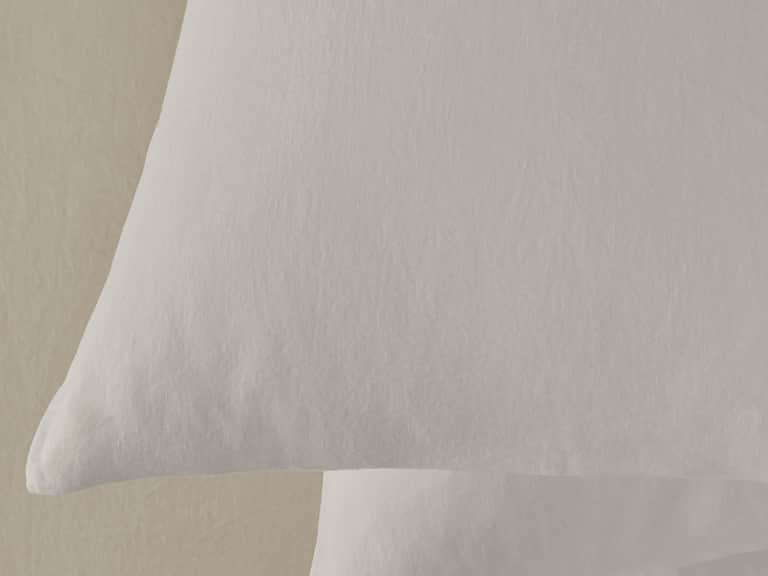
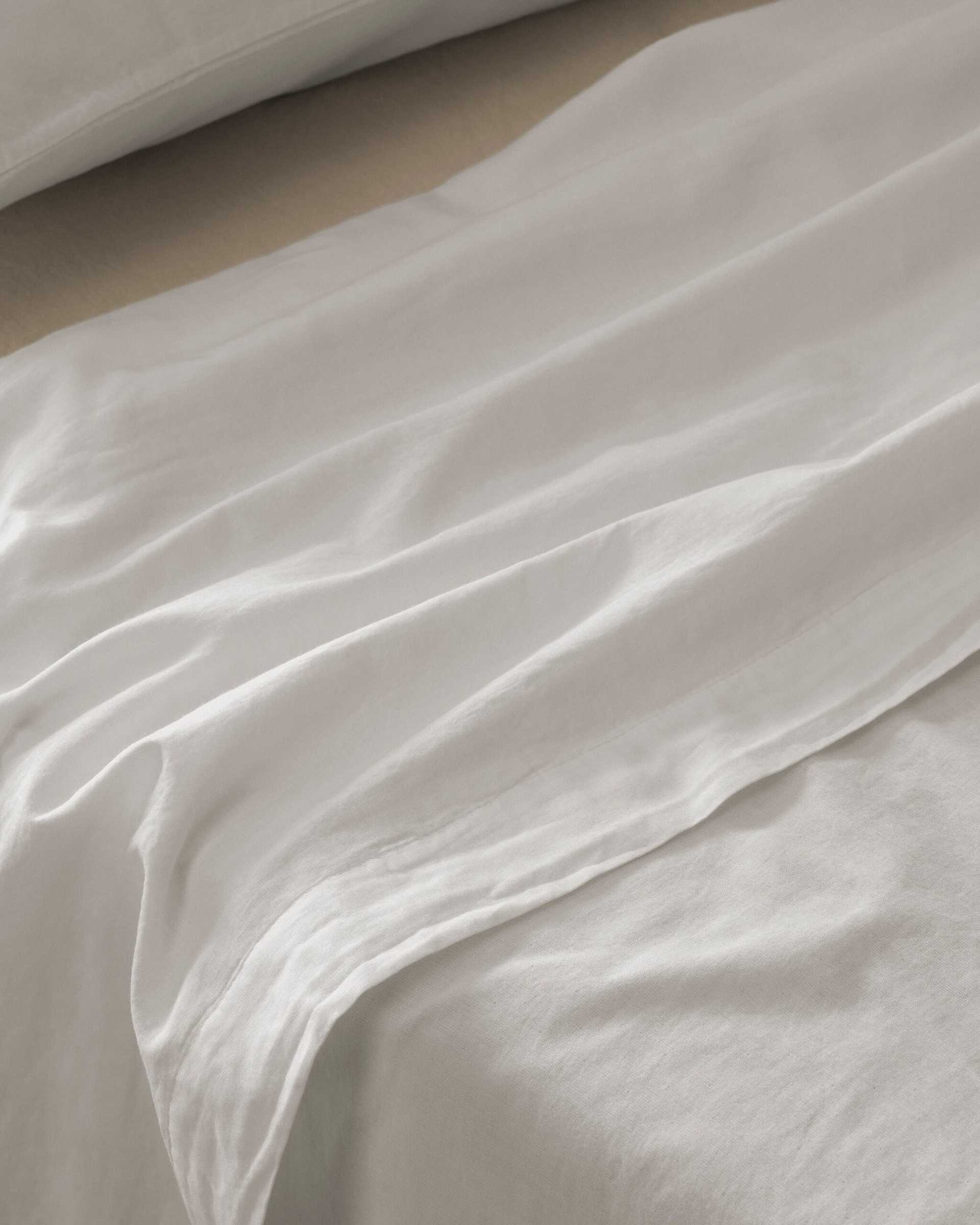
A newly made textile may feel quite different from the same fabric after finishing. Washing, softening, dyeing, and other processes can alter the surface and drape. Naturepedic describes its linen sheets as stone-washed. The process is intended to give cloth a softer, more relaxed character before it reaches the bed, rather than leaving it with the more pronounced crispness some people associate with new linen.
Finishing helps explain why “linen feel” is not a single, fixed thing. A garment-dyed linen, a stone-washed sheet, and a more untreated fabric can share the same basic fiber but present themselves differently. A washed finish may encourage a softer hand and a casually creased appearance. A crisp fabric may have a more structured first impression. Neither is a reliable predictor of whether the sheet will suit an individual: touch, laundering, and time will settle that question.
Finishes also deserve a little scrutiny in product descriptions. Words such as “natural,” “relaxed,” and “luxurious” can suggest a mood without explaining a process. More helpful specifications name the fiber, identify a finish when known, give a fabric weight, and explain care. The more concrete the description, the easier it is to form a sensible expectation.
How a sheet changes after washing
Buying a sheet is not quite the end of the material’s story. Washing can soften it, alter its drape, and reveal whether the fabric’s first impression was representative. Linen is often said to soften over time, but the phrase should not be taken to mean that every fabric will transform in the same way. Some of the change comes from repeated laundering; some reflects the original yarn and finish; some depends on how gently the textile is treated.
Care instructions are therefore more than a note for the laundry room. They are part of the fabric’s specification. Naturepedic’s listed guidance calls for machine washing warm, tumble drying on low, warm ironing if desired, and no bleach. Other linen bedding may call for cold water, a gentle cycle, or line drying. These instructions can vary by maker, finish, dye, and construction, so the label on the particular item should take precedence over general advice.
Practical habits help protect a sheet without turning laundry into a ceremony. Avoid overloading the washer, use a suitable detergent, and keep high heat in check when the care label advises it. Remove bedding from the dryer promptly if the instructions recommend doing so. If a sheet is meant to be ironed, slightly damp fabric is often easier to press; if its appeal lies in the relaxed creases, ironing may be unnecessary.
Chlorine bleach is not recommended in the Naturepedic care details provided. That is a straightforward reminder to read the specific label rather than assume that every white textile should be treated alike. Bleach, excessive heat, and rough handling can all affect fibers and finishes. A routine that preserves the cloth is usually less dramatic than one that tries to make it look untouched.
A practical way to compare bedding materials
Specifications can seem like a small bureaucracy assembled around a pillow. Yet a short, deliberate comparison can make the information useful. Start with the questions that matter in daily life: Do you prefer a smooth surface or visible texture? Do you want a substantial drape, or a lighter layer? Are you willing to follow a more specific care routine? Does the fabric’s origin and certification information answer the questions you have about sourcing?
- Check the fiber content. “Linen” indicates flax-based textile; “100% linen” is different from a blend, while “cotton-linen” identifies more than one fiber.
- Look for provenance stated precisely. Fiber-growing location and place of weaving or manufacture are separate details. Read each claim as written.
- Use weight as context. A gsm figure can help compare fabrics, but it does not independently measure quality, softness, or warmth.
- Ask what the construction tells you. Weave descriptions can explain surface and openness, but a vague phrase is not a substitute for a technical specification.
- Notice the finish. Stone-washed, garment-dyed, or otherwise finished textiles may begin with a different hand from untreated or more structured cloth.
- Read care instructions before deciding. The best fabric on paper is not necessarily the best match if its maintenance feels inconvenient.
This approach keeps the comparison grounded. It also prevents a familiar mistake: treating any one specification as a verdict. “Organic” is not a texture. “Breathable” is not a guarantee of cool sleep. “Heavy” does not mean durable. Each term answers a different question, and no single one can tell the whole story.
What the Naturepedic example can—and cannot—tell you
Naturepedic’s published details sketch a particular kind of linen bedding: organic flax grown in France; a GOTS-certified fabric and facility; a 185 gsm construction; a looser weave; stone washing; and care instructions that allow warm machine washing and low-temperature tumble drying. Together, those details suggest a sheet with linen’s characteristic texture, a considered weight, and a pre-softened, relaxed finish.
They do not tell every reader how the cloth will feel against their skin, whether it will seem airy in a particular bedroom, or how quickly it will soften with their own laundry habits. Sensory experience is personal, and product descriptions can only approximate it. Someone who loves the tactile irregularity of linen may find it immediately familiar; someone accustomed to smooth cotton may need a little time—or may decide that another fabric is better suited to their preferences.
Nor should the word “organic” obscure the ordinary questions of use. Does the fitted sheet fit the mattress? Does the set include the pieces needed? Are the care instructions compatible with the household’s routine? In the Naturepedic specification, the sheet set includes a flat sheet, fitted sheet, and two pillowcases, with a 15-inch pocket on the fitted sheet; sizes listed include queen, king, and California king. Such practical facts are less poetic than fiber origin, but they are often the details that determine whether bedding works in a real room.
For those comparing the sheets with other linen options, it can help to look beyond brand names. A linen pillowcase listed at 172 g/m², for example, offers a separate reference point, while a cotton voile sheet at 100 g/m² shows how different fiber and construction can produce another kind of lightness. Neither comparison proves which will feel best. They help make the language of bedding more legible.
The quiet importance of the hand
People often describe fabric by touch before they know what it is made of. A sheet may seem cool, yielding, dry, crisp, or faintly grainy. Those impressions are real, though they do not always map neatly onto one technical feature. The mind gathers several signals at once: the surface’s friction, the cloth’s temperature, the way it falls, and the sound it makes when moved. A specification sheet separates those elements for analysis; the body encounters them together.
That is why a useful description of bedding should invite attention rather than promise a universal sensation. Fiber, weave, weight, and finish offer reasons a sheet may feel a certain way. They are not a substitute for experience. Naturepedic’s organic flax sheets are worth understanding not because a single number explains them, but because their published details reveal how material choices accumulate into character.
In the end, the best sheet is not necessarily the softest at first touch, the heaviest, or the one with the longest list of credentials. It is the one whose texture, drape, breathability, and upkeep make sense in the life of the person who sleeps beneath it. That answer may emerge on the first night. More often, it takes a few washes, a change in season, and the ordinary passage of time.