Textiles · Bath · Material Guide
Coyuchi Bath Towels: How Fiber, Weight, and Weave Shape Performance
A bath towel is an unusually intimate piece of household equipment: it meets the skin when the day is just beginning or nearly over, and its qualities become apparent through repetition. Fiber, weight, and weave—not softness in isolation—determine whether it absorbs readily, dries between uses, and holds up to the ordinary abrasions of a laundry cycle.
Published November 1, 2026
Shopping for bath towels can feel like entering a small but emphatic vocabulary lesson. Cotton, organic cotton, terry, waffle, GSM, ring-spun, long-staple: each term promises a different kind of comfort, and some promise rather more than a label can prove. The useful question is not simply whether a towel feels plush in a showroom or arrives soft from a package. It is how the cloth behaves after a shower, how quickly it releases moisture into the room, and whether its texture survives the many washings that give a towel its actual life.
This guide offers a practical way to assess Coyuchi bath towels through those material questions. It does not assume that one towel is right for every bathroom, climate, or routine. A thick towel can feel enveloping yet take longer to dry; a lighter one may be easy to launder and quick to air out, while seeming less cushiony. The distinction is not a contest between luxury and utility. It is a matter of matching construction to use.
One preliminary note: product specifications can vary by style and season. Fiber content, fabric weight, weave, dimensions, and care instructions should be checked on the particular towel’s current label or product description. Brand-level impressions are no substitute for the specifications of the individual textile.
Start with the fiber, not the adjective
Fiber is the raw material from which a towel’s character begins. Cotton is the familiar choice for bath towels because it can be spun into absorbent yarns and formed into a looped pile. But “cotton” is a broad description, not a complete account of performance. Staple length, yarn construction, finishing, and the way the fabric is woven all influence how the towel feels and wears.
Longer cotton fibers can be spun into smoother, more cohesive yarns than shorter fibers, though the finished result still depends on the rest of the manufacturing process. Ring-spun yarns are made by twisting and thinning fibers together, a process that can produce a strong, relatively smooth thread. These terms are useful clues rather than guarantees. A towel’s durability cannot be inferred from one technical phrase alone, and a smooth hand at first touch does not establish how the fabric will perform after months of laundering.
Organic certification, when present, answers a different question. It concerns standards applied to fiber production and, depending on the certification, parts of textile processing. It does not automatically mean that a towel is softer, more absorbent, longer-lasting, or faster-drying than a conventional alternative. For a reader weighing environmental claims, certification details matter; for a reader comparing everyday performance, the weave, thickness, construction, and care directions matter too. These are related considerations, not interchangeable ones.
It is also worth separating fiber content from finishing. A towel may be treated or washed to create a softer initial feel. Finishes can affect how the cloth feels in the hand, but the feel can change with use and laundering. A towel that seems slightly firm when new may become more comfortable over time, while excessive detergent or fabric softener can leave residues that interfere with absorbency. The label is a starting point; the laundry routine is part of the textile’s story.
What weight tells you—and what it doesn’t
Fabric weight is often expressed as grams per square meter, or GSM. In broad terms, a higher GSM indicates more textile mass within a given area. In a terry towel, that may come from denser or taller pile, thicker yarns, or some combination of construction choices. This can create a substantial, cushioned feel. It may also mean more water is held in the fabric and more time is needed for the towel to dry.
Weight is useful for comparing towels when the measurements are given in a consistent way, but it is not a direct score for comfort. A heavy towel can feel reassuringly substantial; it can also be cumbersome in a small washer, slow to dry in a humid bathroom, or inconvenient to carry on a trip. A lighter towel can be easier to wash and hang, but may provide less of the enveloping sensation some people want after bathing. Neither description is a verdict. The right balance depends on whether a towel is used in a well-ventilated bathroom, shared by several people, or washed frequently in a household with limited drying space.
Weight should be read alongside construction. Two towels with similar GSM values may feel different because one has longer loops, a different yarn, or a distinct weave. Dimensions matter as well: a generously sized bath sheet contains more fabric than a standard bath towel and may naturally feel heavier in use, even if its material weight is similar. Before comparing product descriptions, check whether the stated weight applies to the fabric, the finished towel, or a particular size.
There is no universal threshold at which a towel becomes “hotel quality” or “luxury.” Such descriptions are often more atmospheric than technical. A more useful comparison asks: Is the weight stated? Does it suit the climate and drying conditions? Will the towel fit comfortably in the household’s washer and dryer? Does its construction offer the feel the user prefers without creating a maintenance burden?
Weave is the towel’s architecture
In a conventional terry towel, loops rise from the ground fabric to create a soft, absorbent surface. The loops increase the cloth’s exposed area and provide the familiar pile that catches water from skin. Loop height and density affect hand feel, bulk, and drying behavior. A deep, plush pile may feel soft and generous, but can retain more water in its structure. A lower or less dense pile may feel firmer and dry more readily.
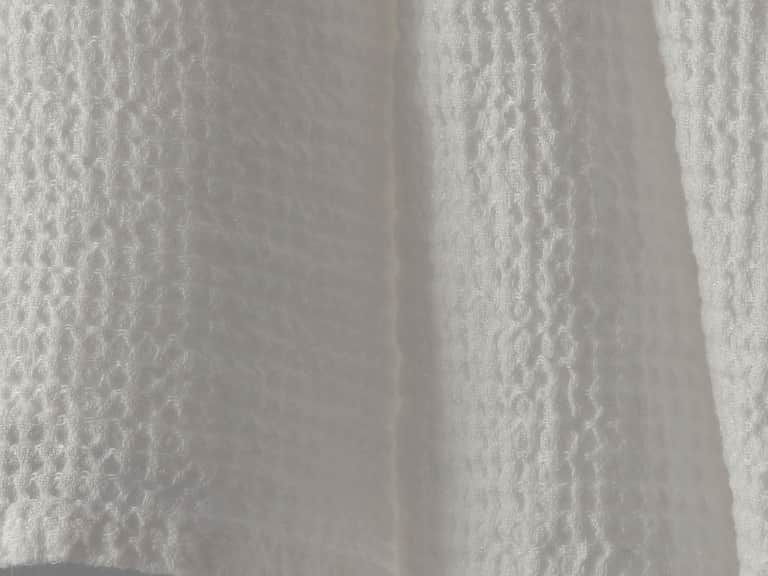
Waffle weave takes another approach. Its small raised cells and recessed channels give the surface a distinct texture while keeping the cloth comparatively open and light. The topography creates places for moisture to move and for air to circulate, though actual absorbency and drying speed depend on the fiber, dimensions, density, and finishing—not on the name “waffle” alone. Waffle towels are often chosen by people who prefer a less bulky feel or want a towel that is easy to hang and store.
For a point of comparison, the Lipe New Towel Set is described as pure linen in a traditional waffle weave. Its product description identifies a textured, light construction and a gentle scrub effect. That example illustrates how a weave can make surface texture part of the experience; it should not be mistaken for a Coyuchi towel or evidence of Coyuchi’s specific product construction. When evaluating any brand, the individual item’s material and weave are the relevant facts.
Plain, ribbed, or patterned constructions can also change the way a towel meets the skin and hangs on a hook. Borders and decorative bands may reinforce edges or provide visual detail, but they are not, by themselves, measures of absorbency. A neatly finished hem is worth noticing because edges are subject to repeated pulling and laundering. Still, the towel’s working surface—the pile or weave that does most of the drying—deserves the greater share of attention.
Absorbency and drying time are not the same virtue
People often use “absorbent” as if it also meant “quick-drying.” The two qualities are connected, but they are not identical. A towel that takes up a large amount of water may hold that water within a thick, dense structure. A lighter, more open towel may absorb enough for ordinary use while releasing moisture more quickly when hung in moving air. Room temperature, ventilation, humidity, and the way a towel is draped all influence the result.
That distinction becomes practical in a household where towels are used repeatedly throughout the day. A thick towel hung in a crowded bathroom may remain damp longer than one spread out on a rail. In a dry, well-ventilated room, the same towel may dry without difficulty. If a towel smells musty between uses, the cause may not be fiber quality; it may be inadequate drying, a crowded hook, or a wash routine that leaves detergent behind.
It is also unwise to expect a towel to behave like a paper product that removes every trace of moisture in a single pass. The feeling of drying depends on the towel’s texture and the user’s preference. Some people want a soft, plush surface; others prefer a more textured cloth that feels brisk against the skin. The test is personal, but the material facts help make the choice less mysterious.
A practical reading of Coyuchi bath towel specifications
When comparing Coyuchi bath towels, begin with the product-specific details rather than assuming that a single brand characteristic applies to every style. Look for the stated fiber composition, any organic or other certification, the weave, fabric weight if provided, towel dimensions, and care directions. If a specification is absent, do not fill the gap with a guess. A precise comparison is possible only when the relevant information is available.
Then consider the circumstances in which the towel will be used. A person who enjoys a thick, enveloping wrap and has ample drying space may value a different construction from someone who washes towels frequently or lives in a humid climate. A shared bathroom may call for several towels that dry reliably between uses. For travel, a smaller and less bulky textile can be more practical than the plushest option in the linen cupboard.
- Fiber: Confirm the exact material and whether the product description distinguishes the towel’s main fabric from any trim or backing.
- Weight: Treat GSM as a comparison point, not a guarantee of absorbency, softness, or longevity.
- Weave: Consider terry pile, waffle texture, or another construction in relation to the feel and drying behavior you want.
- Size: Compare actual dimensions, especially if choosing between a bath towel and a larger bath sheet.
- Care: Follow the care label and account for the drying equipment and space available at home.
It is helpful, too, to distinguish product information from broad claims. Descriptions such as “ultra-absorbent,” “cloud-soft,” or “made to last” may communicate the intended experience, but they are not substitutes for measurements or construction details. Where claims concern environmental impact, certification names and their scope are more informative than a general use of the word “sustainable.”
Care is part of performance
The first wash is not a ceremonial event so much as the beginning of a relationship. New towels can contain manufacturing residues or loose fibers, and washing before use can help prepare them for regular service. The product’s own care label should take priority: temperatures and drying recommendations differ among materials and finishes. If no special instruction is given, a sensible routine generally avoids overcrowding the washer and uses detergent in the quantity recommended for the machine and load.
More detergent is not a reliable route to cleaner towels. Excess soap can remain in the fabric, leaving it less willing to take up water and sometimes giving it a coated or stiff feeling. Fabric softener can also deposit a surface film that affects absorbency. If a towel becomes less effective after repeated laundering, detergent buildup is one possibility to consider before concluding that the fiber has failed. A thorough rinse, used in keeping with the care instructions, may help.
Drying deserves equal attention. Shake out a towel before hanging or placing it in the dryer so that its loops are not needlessly compacted. Avoid leaving damp towels crumpled in a hamper or washer. If tumble drying is permitted, use the temperature and settings recommended on the label; excessive heat can stress fibers over time. Line drying may conserve energy, though it can leave some towels feeling firmer. In either case, a towel needs enough space for air to move around it.
Care instructions are not merely a manufacturer’s formality. They are clues to the material’s tolerances and to the habits that can preserve its texture. If an item is described as machine washable, that does not mean every wash temperature or additive is appropriate. The difference between “washable” and “indestructible” is considerable, and laundry appliances are excellent at making it visible.
Softness changes with use
A towel’s first impression can be misleading in both directions. A very soft new towel may have been washed or finished to create that immediate hand. A towel that feels more textured at first may relax through ordinary washing. The important question is whether its surface remains comfortable and functional under the care routine the household can realistically maintain.
Some changes are normal. Terry loops may flatten slightly with use; colors can lose a little brightness after repeated washing; cotton can shed loose fibers early in its life. These changes do not necessarily mean the towel has become useless. On the other hand, persistent roughness, unraveling seams, or a notable decline in absorbency may indicate wear, unsuitable laundering, or both. Inspecting hems and edges is worthwhile because a small failure at the border can become a much larger one if ignored.
Expectations matter. A towel should be comfortable and useful, but it is still a textile exposed to water, body oils, detergent, friction, and heat. Choosing a material suited to its environment and caring for it according to its label are more dependable strategies than seeking a promise of permanent newness.
Choosing for a real bathroom
In the end, the most persuasive towel is the one that works in the room where it will live. For a warm, humid bathroom with little ventilation, drying time may deserve as much attention as plushness. In a cooler climate, or in a bathroom with ample airflow, a heavier towel may feel worth its slower drying. For a household that does laundry in large loads only occasionally, a bulky bath sheet may be less convenient than its dimensions suggest.
Think about the ordinary choreography: where the towel hangs, how many people use it, whether the washer has room for it, and whether the dryer is regularly available. A towel that cannot dry between uses is not made better by an impressive weight. A lightweight towel that feels too insubstantial to its owner is not automatically the practical choice. The best decision balances touch, absorbency, maintenance, and the conditions of the home.
For Coyuchi bath towels, as for towels from any maker, the useful comparison is therefore not “soft or not soft,” but a cluster of more revealing questions: What is the fiber? How is the fabric constructed? What does its weight suggest about bulk and drying? What does the care label permit? And does that combination suit the way the towel will actually be used?
The quiet intelligence of a good towel
Bath towels rarely receive the kind of attention reserved for a bed or a dining table. They are folded, hung, washed, and folded again, their performance measured in small daily encounters rather than grand occasions. Yet their design is a compact lesson in textile engineering: fiber provides the raw material, weave gives the surface its structure, weight shapes its bulk, and care determines how well the cloth withstands repetition.
Read specifications with curiosity but without reverence. A number is useful when it is clear what the number measures; a marketing phrase is useful only when it points toward a tangible quality. For anyone evaluating Coyuchi bath towels, the most reliable guide is the particular towel’s construction and care information, considered alongside the practical realities of the bathroom. The right choice may be plush, airy, textured, or somewhere between. What matters is that it performs not just in the first moment, but on the hundredth morning too.